
Martin Luther King, Jr. is one of my superheroes. And each time I have walked through The King Center in Atlanta, I have felt something sacred settle into my bones. His legacy is palpable.
I’ve visited several times over the years, most meaningfully with my daughters, because as a mother, a naturalized citizen of the United States, and a human being, I seek true peace in a world still wrestling with racial injustice.
I have a feeling that Martin Luther King Jr. would feel better if the words he eloquently spoke from his heart were not just being quoted but also being practiced. He wasn’t just a wise man who articulated clever quotes, but an advocate, activist, and visionary, seeking to build a better world.
How do we go beyond the quotes and “wise sayings”?
- Study his life
- Read his “I have a dream” speech
- Read his letters, especially those he wrote from jail, and
- Learn the principles of nonviolence
The Living Legacy of Dr. Martin Luther King Jr.
The legacy of Dr. King is not frozen in time. It is alive. It breathes through movements for social justice, our everyday choices in personal relationships, political discourse, and community life.
At the heart of this legacy is Kingian nonviolence—a philosophy, a methodology of nonviolence. It’s a way of life articulated by Dr. Martin Luther King Jr., carried forward by Mrs. Coretta Scott King. Nonviolence is taught globally as a model for nonviolent social change.
Today, we’ll explore the 6 Principles of Nonviolence, which are rooted in the teachings of Martin Luther King Jr., Mahatma Gandhi, and the long tradition of peaceful civil disobedience—from Henry David Thoreau (my boyfriend IYKYK LOL) to the Montgomery Bus Boycott, sparked by the arrest of Rosa Parks in 1955.
The King Center in Atlanta, Georgia
The King Jr. Center was founded by Coretta Scott King. It’s not merely a memorial, but a living institution dedicated to the creation of the Beloved Community.
Let’s define that real quickly:
*** The Beloved Community
MLK’s Beloved Community is a vision of a global society built on justice, equity, peace, and unconditional love. It’s a community where:
- Everyone’s needs are met, and resources are shared
- Poverty and hunger do not exist
- Hate is replaced by universal brotherhood and sisterhood, rooted in compassion
- Differences are embraced and celebrated
- Conflict is resolved through understanding, not violence.
Dr. King’s work during the civil rights movement—from lunch counters to marches, from direct action to courtroom victories—was always grounded in the belief that nonviolent action is a great power, morally superior to the self-defeating method of retaliatory violence.
Key Activities and Attractions of The King Center
These are the must-see and do when visiting The King Center in Atlanta:
- Dr. King & Mrs. King’s Tomb and Reflecting Pool: It’s the final resting place for Dr. King, Coretta Scott King, and other family members. It also features a symbolic and inspiring Eternal Flame.
- Historic Ebenezer Baptist Church: The church where Dr. King preached, now a preserved landmark.
- Dr. King’s Birth Home: Take a tour to see where Dr. King was born and grew up.
- Freedom Hall: Houses exhibits about Dr. King’s life, work, and the Civil Rights Movement.
- King Library and Archives: A vast collection of Dr. King’s papers, audiovisual materials, and records.
- World Peace Rose Garden: A tranquil space for reflection where you can meditate about Dr. King’s legacy.
- Behold Monument: A sculpture honoring the movement for nonviolence and social change.
The visitor center, online courses, interactive exhibits, student art, and virtual tour equip us all understand what nonviolence means.
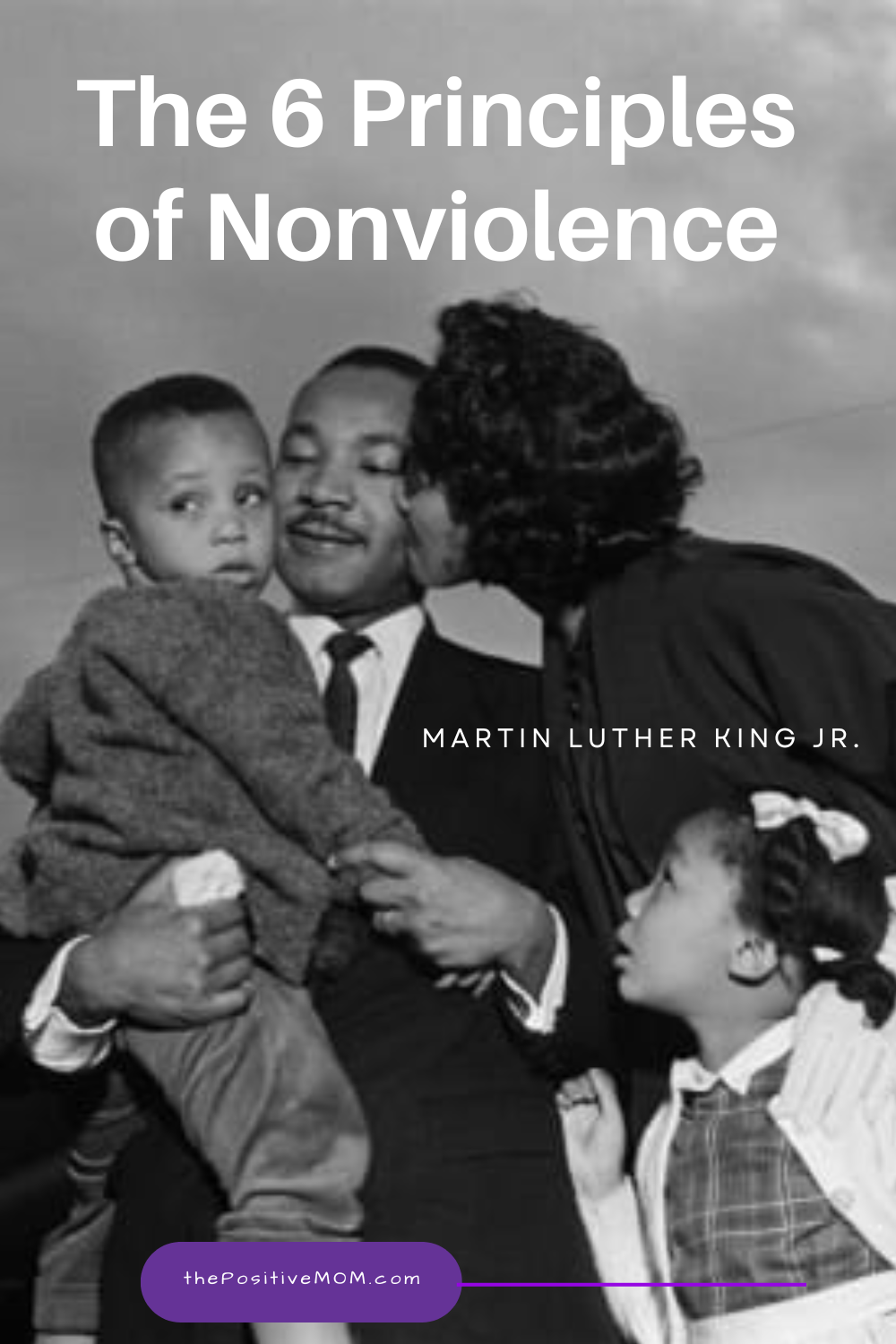
The 6 Principles of Nonviolence are displayed prominently at the King Center for all to see.
The 6 Principles of Nonviolence
Let’s define each!
Principle 1: Nonviolence Is a Way of Life for Courageous People
“Nonviolence is a way of life for courageous people. It is active nonviolent resistance to evil. It is aggressive spiritually, mentally, and emotionally.”
The first—and most important principle—is that nonviolence is not weakness. Nonviolence is way of life chosen by a nonviolent resister with a good conscience.
Dr. Martin Luther King Jr. taught that nonviolence requires deep courage, especially in the face of police brutality, racial discrimination, and unjust laws. It calls for civil disobedience, not out of chaos, but out of love for human dignity.
This principle challenges us all to examine systems rather than demonize particular people. We cannot stand up for the evil that we choose not to see. And I say choose because of the availability of knowledge, information, and historical documentation today. We can certainly become aware of what is wrong and must change.
Principle 2: The Beloved Community Is the Goal
“Nonviolence seeks to win friendship and understanding. The result of nonviolence is redemption and reconciliation. The purpose of nonviolence is the creation of the Beloved Community.”
The goal of nonviolent resistance is not the defeat or humiliation of opponents, but reconciliation—the creation of the Beloved Community.
This vision, central to Dr. King’s vision, imagines a society where racial segregation no longer exists and where true peace is achieved through justice, not domination.
We must remind ourselves that the aftermath of nonviolence is healing, while the aftermath of violence is trauma.
Principle 3: Attack Forces of Evil, Not People
“Nonviolence seeks to defeat injustice, not people. Nonviolence recognizes that evildoers are also victims and are not evil people. The nonviolent resister seeks to defeat evil, not people.”
This principle reminds us that perpetrators of violence are often themselves trapped within unjust systems. Nonviolent love refuses to reduce human beings to their worst actions.
We are all children of God, capable of change, with a backstory worth listening to. I always say, “No one is intentionally misbehaving,” and many find this to be naïveté, controversial, or even insulting, but it is actually moral clarity.
Reverend Martin Luther King consistently taught that hatred corrodes the soul of the hater. Nonviolence separates the evil from the person, allowing space for accountability without dehumanization.
This goes beyond the “I have a dream” Dr. King is known for – it’s not only judging people by the content of their character, but giving them compassion based on the context of the systems in their environment. You know what I mean?
Principle 4: Accept Suffering Without Retaliation for the Sake of the Cause
“Nonviolence holds that suffering can educate and transform. Nonviolence accepts suffering without retaliation. Unearned suffering is redemptive and has tremendous educational and transforming possibilities.”
From the Montgomery Bus Boycott to jail cells across the South, Dr. King Jr. demonstrated that voluntary suffering can be redemptive.
This principle does not glorify pain, but rather recognizes that history shows again and again—from South Africa to the American South—that a nonviolent campaign often requires endurance over the long haul. This is a hard truth and one that is central to the lasting legacy of Dr. King.
Dr. King believed this willingness to suffer, rather than inflict suffering through physical force, revealed what he called the proof of the power of God at work in humanity. It makes me think of a major theme in the teachings of Jesus Christ: “giving someone the other cheek.”
Principle 5: Avoid Internal Violence of the Spirit as Well as External Physical Violence
“Nonviolence chooses love instead of hate. Nonviolence resists violence of the spirit as well as the body. Nonviolent love is spontaneous, unmotivated, unselfish, and creative.”
Nonviolence is not only about what we do—it is about who we become. It’s how we show up in our day-to-day interactions. The principles of non-violence are not about perfection, but about how we strive to embody the peace we wish to see in the world. No wonder Gandhi said “BE the change,” not just “CHANGE.”
This principle addresses internal states: resentment, bitterness, and contempt. I often refer to this as MGE: “Mean Girl Energy.” If you’ve seen the movie or the musical, you know what I mean.
Dr. Martin Luther King Jr. emphasized that hatred within corrodes our capacity for love, justice, and social change. In fact, I believe that harboring any of that energy also sabotages our success in every area of our lives.
The principle of love here is not sentimentality; it is discipline, because love is an action verb. This principle of nonviolence is about choosing a kind of love that sustains movements, families, and communities over years past and future generations.
Principle 6: The Universe Is on the Side of Justice
“Nonviolence believes that the universe is on the side of justice. The nonviolent resister has deep faith that justice will eventually win. Nonviolence believes that God is a God of justice.”
The final principle affirms that moral arc bends toward justice—not automatically, but through faithful action.
This belief was rooted in Dr. King’s deep faith, his role as senior minister, and his conviction that justice aligns with the divine order of the universe. Of course, even though I also call my Higher Power God, we can all see that this principle goes beyond religion. All beloved spiritual teachers and even philosophers agreed with this principle of nonviolence.
From Abraham Lincoln to Rosa Parks, from New York to Selma, history offers proof that courage combined with nonviolence can transform nations, because they become favored.
The Principles of Nonviolence Still Matter
The Civil Rights Act, MLK Day, now a federal holiday and national holiday, and the annual observance on the third Monday of January all exist because nonviolence worked. Nonviolence continues to work – and matter today.
We live in an era of polarized political discourse, racial injustice, and reactive outrage, where violence reigns, and a methodology of nonviolence is desperately needed. As Dr. King warned, violence may bring temporary victories, but it never brings true peace.
Nonviolence is cherished by people like me, who have seen nonviolence, injustice, and systems of oppression as the throughline of their lives, and others who have been placed in places of privilege and power and want to be on the right side of history.
Teaching Nonviolence to Young People
Visiting The King Center with my daughters reminded me that nonviolent direct action, rooted in love and discipline, remains the most effective path to social change. Nonviolence is not outdated. It is not idealistic. It is a tested, powerful, and deeply human response to injustice. The Principles of Nonviolence must be taught—not just as history, but as best practices for life.
To really honor Martin Luther King Jr. and his legacy, we must seek to understand our own biases and isms. We don’t need perfect people; we need people who are committed to seeing color, to seeing challenges, to seeing injustice.
No perfection required. We just need to start with our own beliefs and behaviors. In our homes, schools, workplaces, and communities. Every day.
How do you practice nonviolence? Share how you choose courage over convenience to spread peace, build equity, and offer justice for all.
Founder of the Positive MOM® and creator of the S.T.O.R.Y. System: a blueprint to craft and share powerful stories that will transform your results and help others do the same. Dr. Elayna Fernández is a single mom of 4, an award-winning Storyteller, Story Strategist, and Student of Pain. She’s a bestselling author, internationally acclaimed keynote speaker, and 5x TEDx speaker. She has spoken at the United Nations, received the President’s Volunteer Lifetime Achievement Award, and was selected as one of the Top Impactful Leaders and a Woman of Influence by SUCCESS Magazine. Connect with Elayna at thepositivemom.com/ef and follow @thepositivemom. To receive a gift from Elayna, click HERE.
Want to support the Positive MOM blog?
The mission of the Positive MOM blog is to help moms break trauma cycles, find peace, and feel emotionally whole, so they can practice supportive parenting and create a positive and healthy environment for their children. If you found Elayna’s content valuable, please consider donating a love offering to enable her to keep creating content and helping more moms worldwide. Donate HERE.