
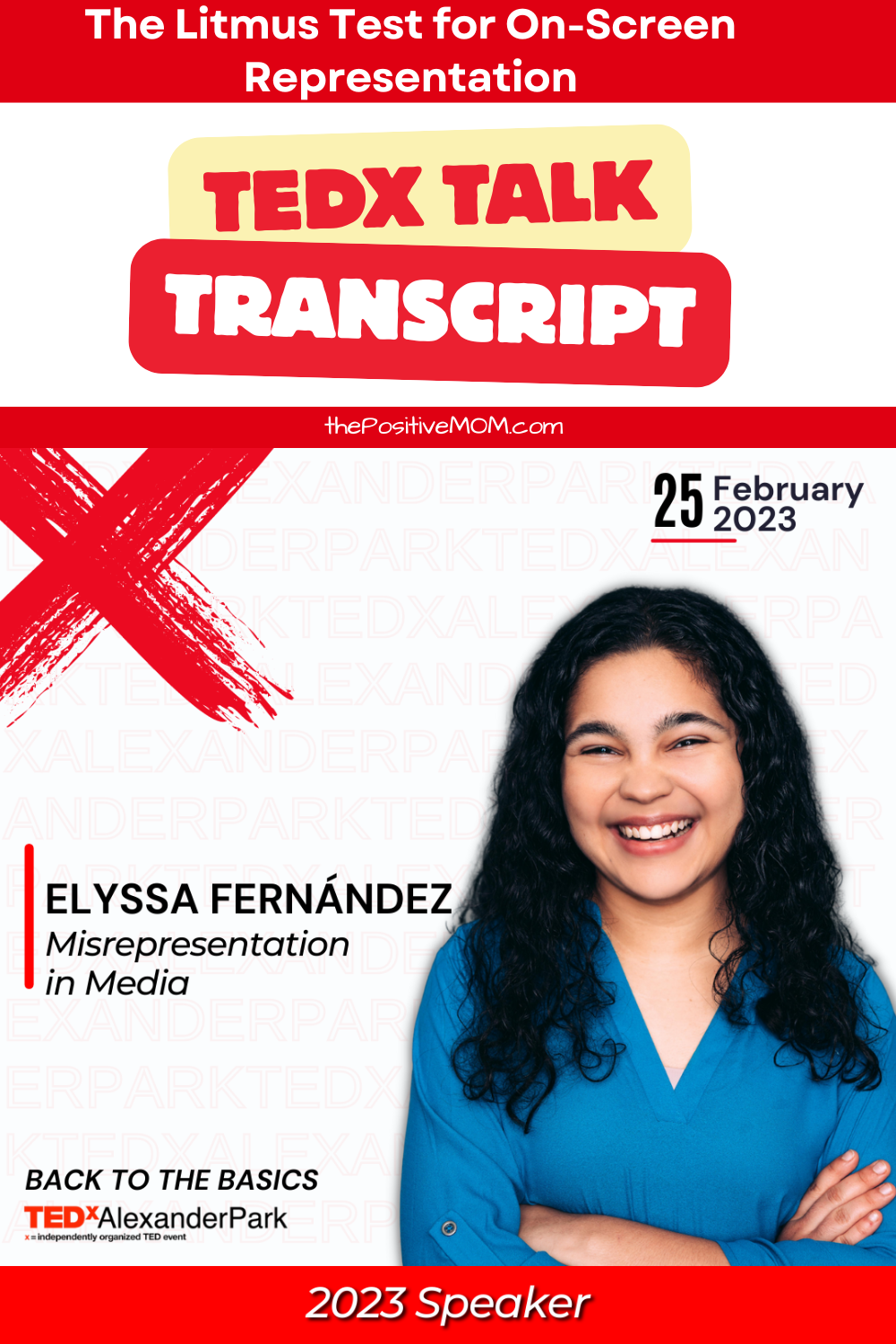
I recently traveled to Georgia to support my second-born daughter, teen entrepreneur Elyssa Fernández, who was speaking at the inaugural TEDx Alexander Park event this year. Her talk, The Litmus Test for On-Screen Representation, is now available to watch on YouTube, and I want to share the transcript and video with you.
The event was organized by seasoned TEDx Speaker and TEDx Licensee Darryll Stinson and co-organized by Former Fortune 100 executive Steven Monahan, as well as the City of Sugar Hill Mayor Brandon Hembree.
The TEDxAlexanderPark live event took place on February 25, 2023 at the Eagle Theater, a state-of-the-art venue in Sugar Hill, GA, highlighting ten brilliant thought leaders from all walks of life with a passion to impact the world.
TEDx Alexander Park
TEDxAlexanderPark’s theme “Back to Basics” came from Theodor Seuss Geisel, also known as Dr. Seuss, and his 1971 book The Lorax. In it, we read the story of an old man named Once-ler who entrusts a young boy with the responsibility to save the future of forestry, animals, and humanity by planting the last Truffula tree seed and resisting the greed of profit-over-planet that nearly led the Once-ler to pioneer an apocalypse.
Speakers were selected around the event goal of manifesting community impact, and included: Ocean Robbins, co-founder and CEO of the Food Revolution Network, Ashley Wright, 2023 Gwinnett County Teacher of the Year; Bucky O’Neil, International Speaker and Mentor; Elyssa Fernandez a young filmmaker, artist, teen entrepreneur, and homeschool high school senior; Lee Richter, Global Leader and award-winning CEO; Ameya Agnihotri, student at the Gwinnett School of Mathematics and Technology; Stephen Schettini, Ex-Monk and thought leader; Iris Grimm, 22 plus year Dog Trainer; Dr. Matisa Wilbon, anthropologist and sociologist; and Travis Hall, lead Pastor of Life Church International.
Who is Elyssa Fernández?
Fernández is a young filmmaker of color and the founder of the Young BIPOC Filmmakers Community, who has researched how “young people everywhere are negatively impacted by the harmful stereotypes that are perpetuated by media – and they internalize what they see on screen.” She discovered that what we see in the media plays a significant part in our beliefs and our perceptions about other people, ourselves, and the world around us.
“What we see shapes who we are,” said Elyssa, “so correct representation on screen is crucial for our society. Growing up, I didn’t see movies with characters that looked like me or shared my experiences. I’m determined to change that, not just for myself, but for everyone who is misrepresented. I’m honored to have been able to share my message with everyone on the TEDx stage.”
But it’s not just teens who are misrepresented on film, media, and TV. TEDx Speaker Elyssa Fernandez also shares: “The representation of marginalized communities in film is often offensive, inaccurate, and harmful – and the stereotypes are everywhere.”
Elyssa Fernández is an artist and an entrepreneur. She and her sister, Elisha, founded their business, WhollyART, at only 8 and 9 years old and published their bestselling book, I Love ME! Self-Esteem in 7 Easy Steps, just a year later. Since then, Elyssa has spoken on stages around the world about self-esteem for kids and teens. She’s passionate about diversity, inclusion, and representation, especially in filmmaking. You can learn more about Elyssa at WhollyART.com and follow her @WhollyART.
What is Elyssa’s TEDx Talk about?
In Elyssa Fernandez’ TEDx talk, you’ll learn more about her unique idea, The Litmus Test for On-Screen Representation, a simple, three-step formula that will transform the narrative about representation, inclusion, and diversity in movies and film.
Fernández also unpacks the 5 most common stereotypes of teens in film, with specific examples of what movies are doing wrong, why representation really matters, and what people everywhere can do to make a difference.
Elyssa’s TEDx Talk
You can watch Elyssa’s TEDx talk on YouTube and on TED.com.
TEDx Talk Transcript: The Litmus Test for On-Screen Representation
I remember the day I turned 13. I was so excited to FINALLY be a teenager!!! There were so many things I’d been waiting to do, like riding in the passenger seat and going to dances, just like my older sister. To celebrate this special occasion, my mom put on my very first PG-13 movie: Mean Girls – a classic.
My sister would laugh until tears came out of her eyes when my mom said, “I’m not a regular mom. I’m a cool mom,” – and she is a cool mom, so I didn’t get it. So after a year of Mean Girls references, I was ready to be in on the joke.
As we sat together on our couch and the plot developed, I kept looking over at my mom and my sister in complete disbelief. What was going on here? The teen characters in this movie had nothing in common with me. Zero. The main character was homeschooled like my sister and I, but even our homeschooling experiences were wildly different.
After the movie ended, I kept thinking about how I didn’t look like any of those girls. I wasn’t thin, tall, or light-skinned. I had very different interests than they did – like writing, art, reading, theater, and film.
And these characters weren’t really dealing with the issues that I was struggling with. In a world where I didn’t see myself onscreen, I was already questioning my identity and my self-worth.
I used to be so confident and unstoppable, and now I was looking in the mirror and hating who I saw. I didn’t look like what the movies said was beautiful.
Instead, the people who looked like me on the screen were called fat, ugly, and unpopular. And I started to see myself that way. And I even thought that the people around me saw me that way, too. I didn’t like myself, and I wished that I could be different.
As I watched movies with characters who were supposed to be my peers, I felt more alone than ever. And teens everywhere experience this. We’re negatively impacted by the negative stereotypes about us that are perpetuated by media. That feeling of isolation we experience when we don’t see ourselves represented or misrepresented is damaging to our self-image. We end up internalizing what we see on screen, whether we realize it or not.
We watch movies to escape and be entertained, so it’s natural to think that what we see in film doesn’t affect us. But science proves it does. Research since the 1960s has consistently shown that what we see on screen actually plays a significant part in how we perceive the world and our beliefs.
Doctor Michael Morgan, a researcher who has studied the effects of media in our society, said: “Stories affect how we live our lives, how we see other people, and how we think about ourselves.”
The stories we consume really matter. And throughout the history of film, we’ve been consuming stories that get the teen experience completely wrong. And that’s not just movies. TV shows, music videos, traditional media, and social media also portray teens differently from how we really are.
As a film enthusiast, teen filmmaker, and person of color, I know firsthand what it’s like to be excluded and misrepresented, and how harmful that really is, so I was inspired to do something about this issue, which is why I created a simple formula I call the litmus test for onscreen representation in film, and I’m looking forward to sharing it with you. But before we go into that, let’s unpack the 5 most common stereotypes that teens face in media:
Stereotype 1: Teens are self-absorbed
Almost every teen movie has at least one character (usually female) who is completely obsessed with themselves. You probably know the one.
Heather Chandler from the movie Heathers, for example, is the most popular girl at school. She mistreats everyone. In her own words, she only cares about “being worshipped.”
Characters like these are one-dimensional. They don’t represent the full teen experience. Just like adults, as teens, we care about our appearance and our social lives because we want to be accepted. Friendships help teens feel a sense of belonging.
According to researchers from the Center for Parent and Teen Communication, it’s crucial in the teen years that we discover our identities outside of our families.
Stereotype 2: Teenagers are lazy
You’ve all probably seen that one meme or some variation of it:
My teenager when they wake up in the morning. Or
My teenager when I ask them to do the dishes.
Teens are typically portrayed as unmotivated and unproductive.
Parents and adults usually have to bribe or threaten teens to get them to do chores or help out.
The reality is that most teens want to be helpful and contribute, but we’re also dealing with a lot of stress.
According to the American Academy of Sleep Medicine, the average teen actually needs anywhere from 8-10 hours of sleep per night – and with school, extracurriculars, homework, family drama, and other life events, is it any wonder that we need rest?
Stereotype 3: Teens don’t have real problems
Perhaps one of the most harmful stereotypes perpetuated by film is that teens don’t have real problems. Adults and movies in media usually write off our feelings as being “too dramatic.”
Yes, our moods do change very quickly. We’re either really up or really down, and that can change in a matter of seconds, but that’s because our brains are developing, our bodies are changing, our social dynamics and our friend groups are shifting, and all that takes its toll.
We’re trying to prepare for the future, on top of that, and all of this is even harder for teens who face disadvantages and discrimination.
So the bottom line is this: We’re trying to figure out our place in this rapidly and ever-changing world, and discovering WHO WE ARE. It’s a pretty big deal.
Stereotype 4: Teens are out of control
Now, a lot of examples of that particular trope probably just went through your mind. That’s because it’s the most popular depiction of teens in the media. Teens are either engaging in unsafe sex, dangerous drug use, reckless partying, or all of the above.
But you’ll probably be just as surprised as I was when you hear this: Pew Research states that anywhere from 59% to 84% of teens under eighteen have never had sex. And the National Institutes of Health has proven that teenage drinking is at an all-time low!
Real teens do have unhealthy coping mechanisms. Most of us do. Who doesn’t? But media uses these extreme examples irresponsibly for effect and fail to leave out the the context. These self-destructive behaviors are usually caused by traumatic situations and untreated mental illness.
And those same films fail to portray teens who are preparing for their future, are passionate about creating positive change in the world, and are already doing incredible things in their communities.
Stereotype 5: Teenagers look like adults – and we’re all same
This is the biggest problem, the stereotype that’s most damaging stereotype to our self-image as teens.
Growing up, I loved Cole Sprouse and his Suite Life on TV. So when I saw that he was playing the character of Jughead, I knew that he wasn’t eighteen – he wasn’t even a teen. He was actually 24 when the series came out- and now he’s 30 years old and he’s still playing a teen character. And this isn’t uncommon.
Rachel McAdams played 17-year-old characters in two different movies in 2004 – when she was 27 –10 years older than her characters.
Cole and Rachel are icons and incredible actors, so what’s the problem? It’s that teens are comparing themselves to the teens they see on-screen – and it’s not a fair comparison.
Our voices are cracking, our bodies are growing, we’re getting acne, and our bodies, skin colors, hair types, cultural backgrounds, circumstances, and abilities are diverse.
We all deserve to be portrayed as we really are and feel like we belong. Unfortunately, when we actually do see people like us on screen, the representation is usually offensive and inaccurate. And it’s my mission that we do better.
As I compare the movies I watched while growing up to what we’re seeing today, I can definitely see that representation has come a long way, and it makes me feel so happy. But there’s a lot more work to be done. I believe that it’s important to both celebrate our progress while continuing to improve.
And that’s why I created the litmus test for teen representation.
It’s very simple: Whenever you see a character on screen, ask yourself this question. “Is this portrayal respectful, accurate, and responsible?”
Let’s break that down.
- Is it respectful? Is the portrayal of teens demeaning or hurtful in any way? Was something offensive used for comedic effect?
- Is it accurate? Does this portrayal reflect the teens in our diverse world? Is the teen character propagating a harmful stereotype?
- Is it responsible? Could the portrayal be detrimental to teens and how they view themselves? Will this portrayal have a negative impact on the attitudes or behaviors of the teens or adults who watch it?
Now I’m not telling you to stop watching your favorite movie or boycott every teen movie or series that’s unrealistic – that would be too much. After all, in my family, it’s tradition to watch Mean Girls every October 3rd! If you know, you know.
What I do ask of you is to notice teen stereotypes and ask yourself these three questions: “Is it respectful? Is it accurate? Is it responsible?”
And if that movie or TV show doesn’t check the boxes, speak up! Send a tweet, a story, or a post sharing what you think. Start a positive discussion online or with your friends, family, and the teens in your life about what we need to see in film when it comes to teens.
Teens may be the future, but we’re also the present. We’re not just the next generation, we’re shaping society right now. So what we’re seeing and how we see ourselves matters.
When media represents us respectfully, accurately, and responsibly, it will have a positive impact on our self-image and the narrative about teens can change for the better.
I invite you to be a part of this movement. What we see shapes who we are. I invite you to be part of this movement so we can create and encourage the creation of media and movies that can shape a better world for us all.
What do you learn from Elyssa’s TEDx Talk?
Share with us in the comments below. I am proud of her and her work and the impact it makes in the world.
Founder of the Positive MOM® and creator of the S.T.O.R.Y. System: a blueprint to craft and share powerful stories that will transform your results and help others do the same. Dr. Elayna Fernández is a single mom of 4, an award-winning Storyteller, Story Strategist, and Student of Pain. She’s a bestselling author, internationally acclaimed keynote speaker, and 5x TEDx speaker. She has spoken at the United Nations, received the President’s Volunteer Lifetime Achievement Award, and was selected as one of the Top Impactful Leaders and a Woman of Influence by SUCCESS Magazine. Connect with Elayna at thepositivemom.com/ef and follow @thepositivemom. To receive a gift from Elayna, click HERE.

Want to support the Positive MOM blog?
The mission of the Positive MOM blog is to help moms break trauma cycles, find peace, and feel emotionally whole, so they can practice supportive parenting and create a positive and healthy environment for their children. If you found Elayna’s content valuable, please consider donating a love offering to enable her to keep creating content and helping more moms worldwide. Donate HERE.